_edited.png)
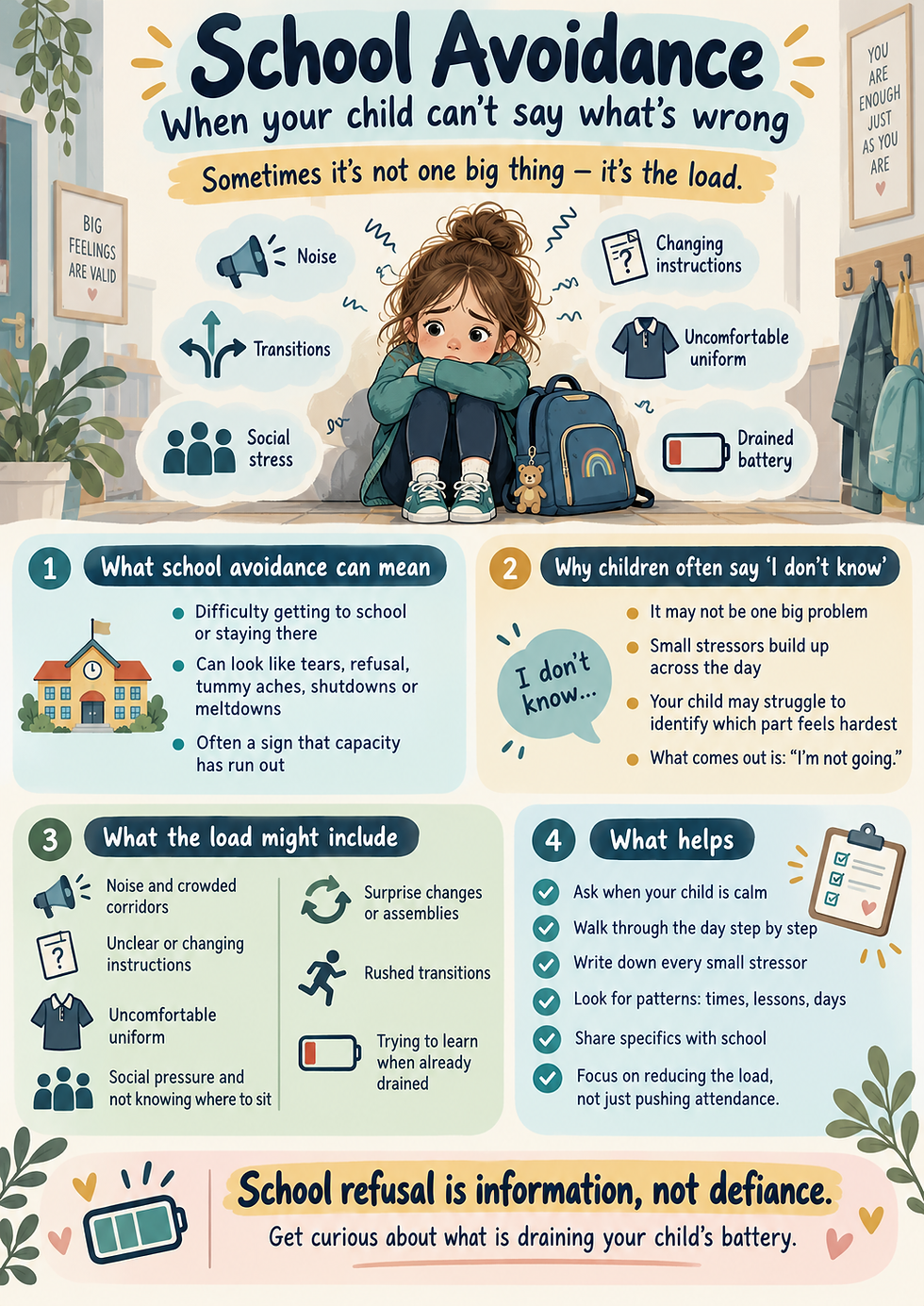
School Avoidance: When Your Child Can't Say What's Wrong

If your child screams, refuses or melts down before school, you've probably already asked all the right questions.
"Is someone being mean to you?" "No."
"Is it a particular teacher?" "I don't know."
"Is the work too hard?" "Not really."
And yet they still can't get out of the door.
You're left standing in the hallway with their shoes in your hand, wondering what on earth is going on. Is it anxiety? Is it defiance? Did you miss something?
Here's what I see again and again in my work with neurodivergent children and their families: school avoidance doesn't always have one obvious cause. Sometimes there isn't a single big thing your child can point to. Sometimes we need to stop looking for the thing, and start looking at the load.
What is school avoidance?
School avoidance (also called school refusal, or emotionally based school avoidance, EBSA) is when a child finds it extremely difficult to go to school, or to stay there once they arrive. It can look like tummy aches on a Sunday night, tears at the gate, refusing to get dressed, or a full meltdown at 8am.
It is not laziness, and it is rarely about "not wanting to learn". Very often, it's what happens when a child's capacity has run out, and their nervous system is telling them, as loudly as it can, that it cannot manage another day.
Why "what's wrong?" so often gets "I don't know"
When we ask our children what's wrong, we're usually looking for one cause we can fix. A bully. A teacher. A subject.
But for many children, especially autistic children, children with ADHD, and those with sensory or processing differences, the difficulty isn't one big thing. It's the noisy corridor. The teacher changing the instructions. The uncomfortable uniform. Not knowing who to sit beside. The surprise assembly. The rushed transition. Holding it together when someone annoys them. Trying to concentrate when their brain is already tired.
Tiny stressor. After tiny stressor. After tiny stressor.
None of these on its own seems big enough to explain the screaming at the front door. So when you ask, your child genuinely may not know which one to name. Until eventually their capacity runs out, and all that comes out is: "I'm NOT going to school."

What cumulative stress at school can look like
To show you how this builds, here is a picture drawn from a young person I've worked with (identifying details removed). When we sat down together, calmly and well away from the morning rush, and asked what was hard, she didn't name one thing. She named dozens.
Adults and expectations that don't make sense
Some teachers felt shouty or very strict, and she couldn't work out what they wanted from her, however hard she tried.
Inconsistent expectations, like being brought into class, seated, then sent back outside to repeat the line-up, left her feeling she'd done something wrong even when she was following instructions.
Rules without a clear reason (lining up, the morning coat routine, getting equipment organised) were hard to accept because she couldn't see their purpose.
Being asked to repeat the teacher's question was frightening, because she might hear a question but not process or hold on to it.
Equipment expectations seemed to keep changing, even when they were written on a sign.
Form time and the people in the room
She liked her usual form tutor, but the teacher changed every Wednesday.
None of her close friends were in her form, and there was a group she didn't feel comfortable around.
There was often nothing to do, so she sat there feeling worse before the first lesson had even started.
Noise, crowds and transitions
Some lessons were very noisy, and noise made it hard to concentrate.
Assemblies and whole-group activities meant being packed in with lots of people.
Moving between lessons, with several year groups on the move at once, felt like a "dodging game": loud, unpredictable and exhausting.
Every transition also meant working out which equipment she needed next.

A battery that doesn't recharge between lessons
Most importantly, her capacity didn't reset between lessons. One difficult lesson in the morning made the next one harder. A noisy room, plus people she found difficult, plus a lesson that already drained her, all added up. By lunchtime, her battery could be close to empty.
Look at that list again. Not one item would make most adults say, "Well, of course she can't go to school." But together? That is an enormous daily load for a child who is also expected to learn.
Stop looking for the thing. Start looking at the load.
When school avoidance appears, it's tempting to hunt for the single cause. For many children, the more helpful question is: what is draining their battery, and when?
Here's where to start:
Ask at the right moment. Children usually know what's hard for them; we just need to ask when they're calm, not mid-meltdown or in the morning rush. Car journeys, walks and bedtime chats often work well.
Get specific. Instead of "How was school?", walk through the day together: "What's the coat bit like in the morning? What happens in form? What's the corridor like after maths?"
Write it all down. List everything your child finds hard, however small. The small things are exactly the point.
Look for patterns. Are Wednesdays worse? Is the afternoon harder after a particular lesson? Patterns show you where the load piles up.
Share the list with school. A clear, specific list is far more useful than "she's anxious". It helps staff make small changes: leaving lessons a few minutes early, a quiet space during form, explaining the reason behind a rule, or written instructions instead of repeating questions aloud.
Reduce the load, don't just push attendance. Removing even a few stressors can free up enough capacity for your child to cope with the rest.
School refusal is information, not defiance
When your child says "I'm not going," it can feel like a battle of wills. But refusal is information. It's your child telling you their capacity has run out, even if they can't yet tell you why.
Your job isn't to win the morning. It's to get curious about what's underneath it, and to work with your child and their school to lighten the load.


Comments