_edited.png)
Choosing Your Battles: Why Some Boundaries Can Wait When Your Child Is Overwhelmed

It's 8.15am. You're already late. Your child is on the floor by the front door, one shoe on, the other flung across the hallway, and the noise building inside them is one you know far too well.
Every part of you wants to hold the line. Shoes on. Now. Because if you let this go, what are you teaching them?
I've been that parent. For a long time I believed every hard moment was something I had to win. Then I started to notice something uncomfortable: my reactions weren't calming the meltdown. They were adding to it.
This post is about the shift that changed things in our house, and in the families I work with now. Not every boundary needs to be held in every moment. Sometimes the most helpful response isn't pushing harder. It's recognising what can wait.
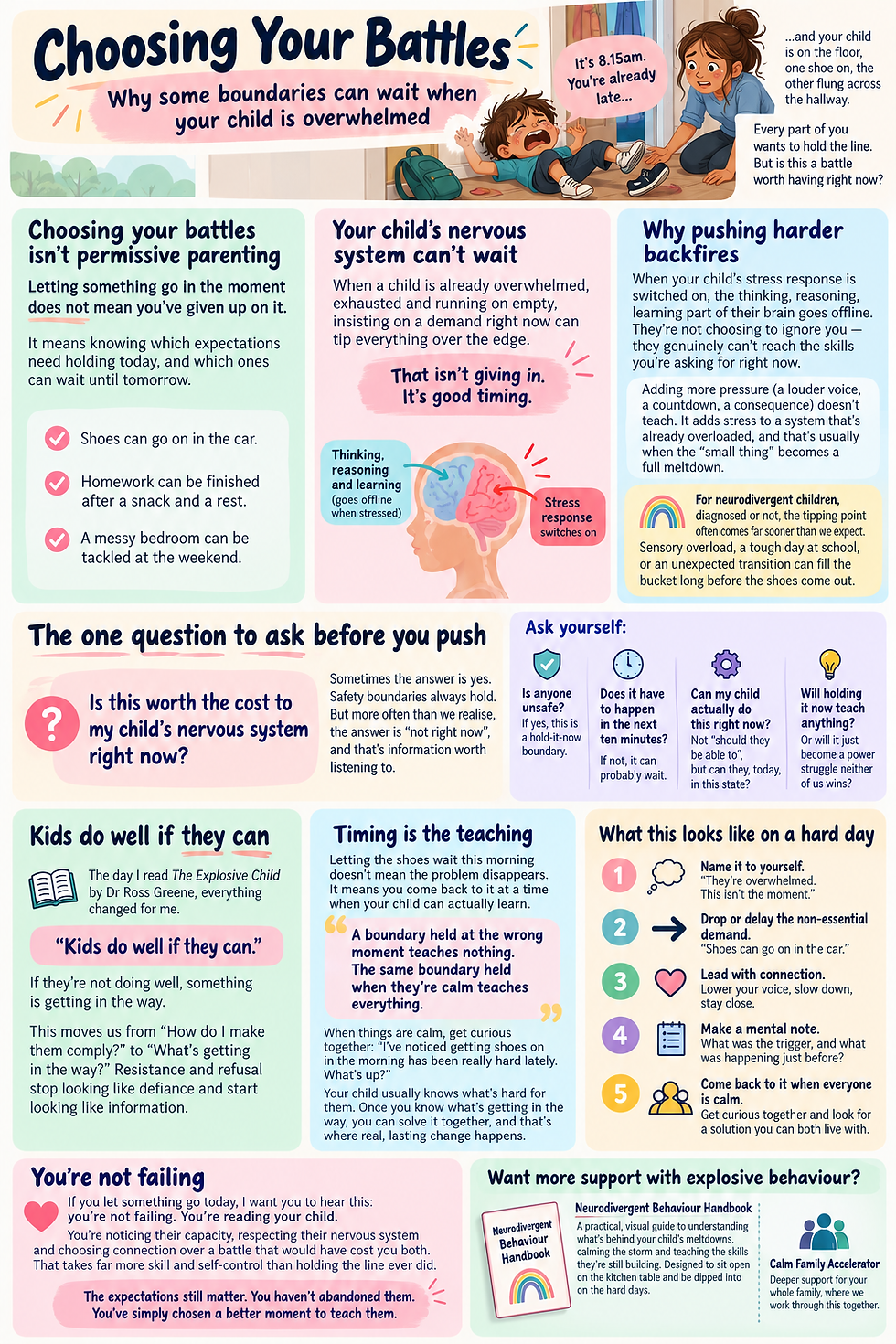
Choosing your battles isn't permissive parenting
Let's get this out of the way first, because it's the fear that stops most parents. Letting something go in the moment does not mean you've given up on it.
Choosing your battles means knowing which expectations need holding today, and which ones can wait until tomorrow. Shoes can go on in the car. Homework can be finished after a snack and a rest. A messy bedroom can be tackled at the weekend.
Your child's nervous system can't wait.
When a child is already overwhelmed, exhausted and running on empty, insisting on a demand right now can be the thing that tips everything over the edge. That isn't giving in. It's good timing.
Why pushing harder backfires when your child is dysregulated
When your child's stress response is switched on, the thinking, reasoning, learning part of their brain goes offline. They're not choosing to ignore you. In that state, they genuinely can't reach the skills you're asking for: flexibility, patience, waiting, shifting from one thing to the next.
So when we add more pressure (a louder voice, a countdown, a consequence), we're not teaching. We're adding stress to a system that's already overloaded. That's usually the moment the "small thing" becomes a full meltdown.
For neurodivergent children, diagnosed or not, that tipping point often comes far sooner than we expect. Sensory overload, a tough day at school, a transition they didn't see coming: the bucket can be full long before the shoes ever come out.
The one question to ask before you push
Before you push that expectation, pause and ask yourself one question:
Is this worth the cost to my child's nervous system right now?
Sometimes the honest answer is yes. Safety boundaries hold, always, and some things genuinely can't move. But far more often than we realise, the answer is "not right now", and that's information worth listening to.
A few follow-up questions can help you decide in the moment:
Is anyone unsafe? If yes, this is a hold-it-now boundary.
Does it have to happen in the next ten minutes? If not, it can probably wait.
Can my child actually do this right now? Not "should they be able to", but can they, today, in this state?
Will holding it now teach anything? Or will it just become a power struggle neither of us wins?
Kids do well if they can
The day I read The Explosive Child by Dr Ross Greene, everything changed for me. His core idea is simple, and it turned my thinking upside down: kids do well if they can. If they're not doing well, something is getting in the way.
That one idea moves us from "How do I make them comply?" to "What's getting in the way?" Resistance and refusal stop looking like defiance and start looking like information.
I went on to train in Dr Greene's Collaborative & Proactive Solutions (CPS) model because of my own two boys. The biggest lesson it taught me? Stop trying to win the moment, and start understanding it.

Timing is the teaching
Here's the part that matters most. Letting the shoes wait this morning doesn't mean the problem disappears. It means you come back to it at a time when your child can actually learn.
A boundary held at the wrong moment teaches nothing. The same boundary held when they're calm teaches everything.
Later, when things are calm (in the car, at bedtime, over a snack), you can get curious together. Something like: "I've noticed getting shoes on in the morning has been really hard lately. What's up?"
Children usually know what's hard for them. We just have to ask at the right moment. Maybe the socks feel wrong. Maybe mornings feel rushed and chaotic. Maybe they're dreading something at school. Once you know what's getting in the way, you can solve it together, and that's where real, lasting change happens.
What this looks like on a hard day
Name it to yourself: "They're overwhelmed. This isn't the moment."
Drop or delay the non-essential demand: "Shoes can go on in the car."
Lead with connection: lower your voice, slow down, stay close.
Make a mental note: what was the trigger, and what was happening just before?
Come back to it when everyone is calm: get curious together and look for a solution you can both live with.
You're not failing
If you let something go today, I want you to hear this: you're not failing. You're reading your child.
You're noticing their capacity, respecting their nervous system and choosing connection over a battle that would have cost you both. That takes far more skill and self-control than holding the line ever did.
The expectations still matter. You haven't abandoned them. You've simply chosen a better moment to teach them.
Want more support with explosive behaviour?
If shoes, screens, homework or bedtime keep turning into battles in your house, the Meltdown Decoder helps you work out what’s really going on, so you know which battles to pick and when.
Choose the situation you’re stuck with, answer a few quick questions, and you’ll get a tailored response showing which skills are still building, which sensory needs aren’t being met, what to do right now, what to try before next time, and exactly what to say instead. There’s a red Meltdown First Aid button on every screen for the moments you need help straight away.


Comments