_edited.png)
Screen Time Meltdowns with ADHD & Autistic Kids (And How to Help)

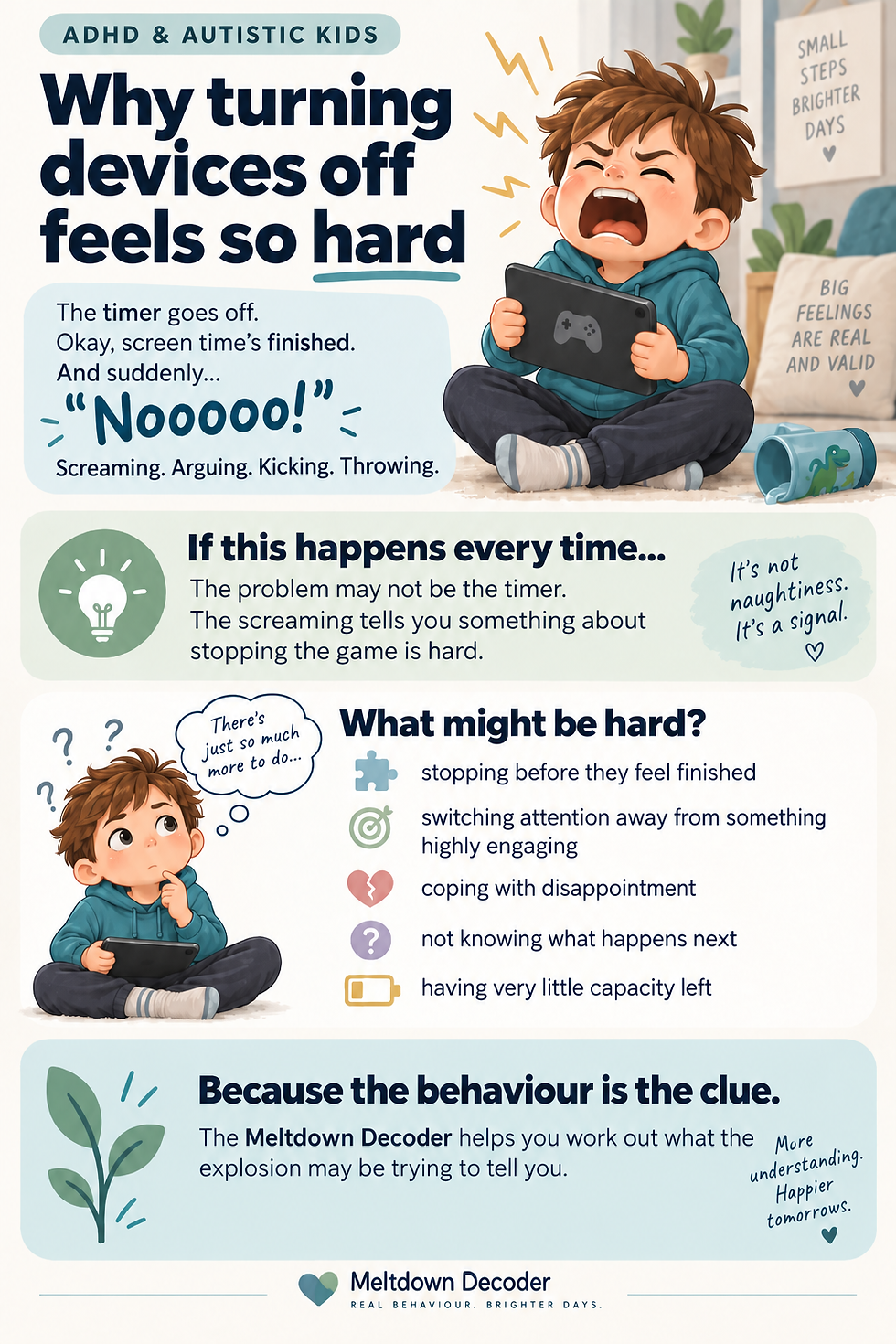
You gave the ten-minute warning. Then the five. Then the two. You were calm. You were fair. You did everything the parenting advice told you to do.
And still — You end up with Screen Time Meltdowns with ADHD & Autistic Kids
If ending screen time is the most reliable flashpoint in your house, you are not doing it wrong. And your child is not doing it on purpose. Something is happening underneath the behaviour that almost nobody explains to parents, and once you can see it, the whole battle changes shape.
Your child isn't addicted to the iPad- the truth about Screen Time Meltdowns with ADHD & Autistic Kids
The word most parents get handed is addiction. It's an easy word, and it puts the problem neatly inside the child: they can't control themselves, they want it too much, they need to learn to cope.
But it doesn't explain what you're actually seeing. A child who is "addicted" would fight equally hard for every enjoyable thing that ends. Yours probably doesn't. They can leave the park. They can put down a book. They can stop a jigsaw halfway. It's the screen — and specifically the ending of the screen — that reliably brings the house down.
That's a clue. The problem isn't the pull of the device. It's what the device was doing for your child's brain, and what happens the moment it stops.
What screens actually do for a neurodivergent brain
For ADHD brains: a rare, reliable hit of interest
An ADHD brain doesn't run on importance. It runs on interest, novelty, urgency and challenge. This is why your child can't start their homework but can spend three hours building something extraordinary in Minecraft — and it's not a motivation problem, it's a wiring difference.
Games and videos are built to deliver exactly what that brain struggles to generate on its own: instant feedback, clear goals, escalating challenge, no ambiguity about what to do next. A maths worksheet offers a vague reward in three weeks' time. A game offers one every eleven seconds.
So when you switch it off, you're not just ending an activity. You're switching off the one thing in the day that made your child's brain feel focused and capable — and dropping them back into a world where nothing works that well.
For autistic brains: deep focus that feels like relief
Many autistic children have what's often described as a single-channel attention system. When they're in something, they're properly in it — deeply, completely, with the rest of the world switched off.
That state isn't a bad habit. It's frequently the most comfortable your child feels all day. The screen is predictable. It follows rules. It never changes its mind, never uses sarcasm, never expects them to read a facial expression correctly under pressure.
Being pulled out of that isn't like being tapped on the shoulder. It's more like being dragged out of deep sleep — disorientating, physically unpleasant, and impossible to do gracefully.
For both: it's often the calmest part of the day
If your child has spent six hours at school holding themselves together — managing noise, following unwritten social rules, sitting still, coping with the strip lights and the dinner hall and the unexpected supply teacher — they arrive home with nothing left.
The screen is where they put themselves back together. It asks nothing of them. For a lot of neurodivergent children, screen time isn't indulgence; it's decompression.
Which means "time's up" can land as: the recovery is over, and you have to go back to being on show.
Why "five more minutes" doesn't work
Time doesn't feel the same to your child
Many ADHD and autistic children experience time as now and not now, with very little in between. A five-minute warning assumes your child can feel five minutes passing and prepare themselves during it. Most can't. The warning registers as "not now" — and then, with no sense of it approaching, the ending arrives out of nowhere like an ambush.
From the outside it looks like they ignored you. From the inside, it genuinely came out of the blue.
Stopping is an executive function skill
We talk about "just turning it off" as though it's one action. It isn't. It requires your child to pull their attention out of something absorbing, hold the instruction in mind, override a strong impulse, tolerate the disappointment, and start a completely different activity — all in about four seconds.
Those are executive function skills, and they are typically delayed by several years in neurodivergent children. Your ten-year-old may be attempting this with the switching skills of a six-year-old. They're not refusing the task. They're being asked to do something they don't yet have the tools for.
The unfinished loop
There's one more thing, and it's badly underrated: an unsaved level, an unfinished build, a video stopped four minutes from the end. For a brain that struggles with incompletion, being cut off mid-loop can be genuinely distressing — not disappointing, distressing. The protest you get is often about the unfinished thing, not about the screen at all.
The crash afterwards isn't drama
Here's the part that catches parents out. Even when the handover goes reasonably well, the twenty minutes afterwards can be dreadful — irritable, tearful, snappy, hostile over nothing.
That's a nervous system that has gone from a highly stimulating, tightly structured, predictable environment to a quiet, unstructured, unpredictable one in a single step. It's a sensory and cognitive drop, and the wobble that follows is a regulation crash, not a character flaw.
The behaviour is the aftershock. The transition was the earthquake.
Your child isn't fighting you over a screen. They're fighting the feeling of being pulled out of the one activity that finally made their brain feel comfortable.
Six things that actually help
1. End at a finish line, not a number
Clock time is arbitrary and invisible. Task time is concrete. "Two more races," "until the end of this episode," "once you've saved and got back to base" gives your child something they can actually see coming — and lets them close the loop instead of being severed from it.
It sounds small. For a lot of families it removes most of the fight on its own.
2. Let your child be the one who presses stop
There's a big difference between having something taken and choosing to put it down. Where you can, hand over the final action: they set the timer, they save the game, they press the button. Autonomy at the point of transition takes an enormous amount of heat out of it — particularly for children who are sensitive to feeling controlled.
3. Warn the body, not just the ears
A verbal warning has to compete with a game that is designed to hold attention. Give it a physical form: a visual timer they can see draining, a specific song that means "one song left," sitting down beside them for the last few minutes instead of calling from another room.
Physical presence and a visible countdown do far more than volume ever will.
4. Build a landing pad
Never end a screen into a vacuum. "Turn it off" is much harder than "turn it off, snack's on the table." Have the next thing ready, physical and low-demand: food, a bath, the dog, LEGO on the floor, ten minutes in the garden.
You're not bribing them. You're giving a dysregulated nervous system somewhere soft to land.
5. Do the negotiating when everyone is calm
Nothing gets solved at 6pm on a Tuesday with a screaming child. Sit down at a neutral moment — a car journey is ideal, no eye contact required — and ask genuinely: *what's the hardest bit about switching it off?* You may hear something you'd never have guessed. Children often know exactly what the problem is; they're just never asked while they're calm enough to say it.
Then build the rule together. A plan your child helped design is one they have a reason to keep.
6. Look at what happened before the screen
If the meltdowns cluster on particular days, the screen probably isn't the variable. Check what came before: a difficult day at school, a substitute teacher, PE, a missed snack, a fluorescent-lit assembly. A child who is already at the edge of their capacity will blow at whatever comes next — and screen time is very often just the thing that happens to come next.
When it's the same battle every single day
Two children can look identical at the point of the meltdown and need completely opposite things. One is dysregulated from sensory overload and needs the room quiet and dim. One is stuck on an unfinished task and needs to be allowed to complete it. One is exhausted from masking all day at school. One is fighting the loss of control, not the loss of the screen.
Generic screen time advice fails because it treats all of these as the same problem. They aren't — and the wrong strategy applied to the right child makes everything worse.
If you're stuck in the same loop night after night, the most useful thing you can do is work out which of these is actually driving your child's behaviour. That's exactly what the Meltdown Decoder is built to do: walk you through what you're seeing and identify the specific unmet need underneath it, so you can stop guessing and start responding to what's really there.

Frequently asked questions
Is screen time actually bad for ADHD and autistic children?
Not inherently. For many neurodivergent children screens serve a real function — regulation, decompression, connection, and a rare experience of competence. What matters far more than the total number of hours is what the screen is displacing, how the endings are handled, and whether your child has other reliable ways to regulate. Blanket limits tend to be less effective than thoughtful transitions.
Should I use a timer?
Timers help some children and inflame others. A visible countdown timer works well for children who struggle to feel time passing. But if your child experiences a ticking clock as pressure, or if the timer routinely lands mid-task, it can make things considerably worse. Task-based endings — finishing the level, the episode, the build — are usually the safer starting point.
Why is my child fine at school but falls apart at home after screens?
Because school takes everything they have. Many neurodivergent children hold themselves together all day and only release at home, where it's safe. Screen time often sits right at that release point, so the transition off it becomes the moment the day's accumulated stress finally comes out. The screen is the trigger; the school day is usually the cause.
How much screen time is right for a neurodivergent child?
There's no reliable universal number, and chasing one tends to create more conflict than it resolves. Look instead at function: is your child sleeping, eating, moving, and connecting with people? Can they leave the screen with support without it wrecking the evening? Are they using it to recover, or to avoid something that needs addressing? Those questions tell you far more than a stopwatch will.
Is it okay to let my child use screens to calm down?
Yes — and for a lot of families it's a genuinely valuable regulation tool. The thing to keep an eye on is whether it's the only tool. If screens are your child's single route back to calm, it's worth slowly building others alongside it: movement, water, deep pressure, music, a specific comfort activity. Not to replace the screen, but so your child has more than one door out.
Screen time battles are exhausting, and they're rarely about what they appear to be about. Your child isn't trying to make your evening harder. They're struggling with a transition that asks more of their brain than it can currently deliver — and that's something you can support, once you can see it clearly.

Comments